Showing posts with label AI. Show all posts

Tuesday, 28 March 2023

Who Is This


Who are they?
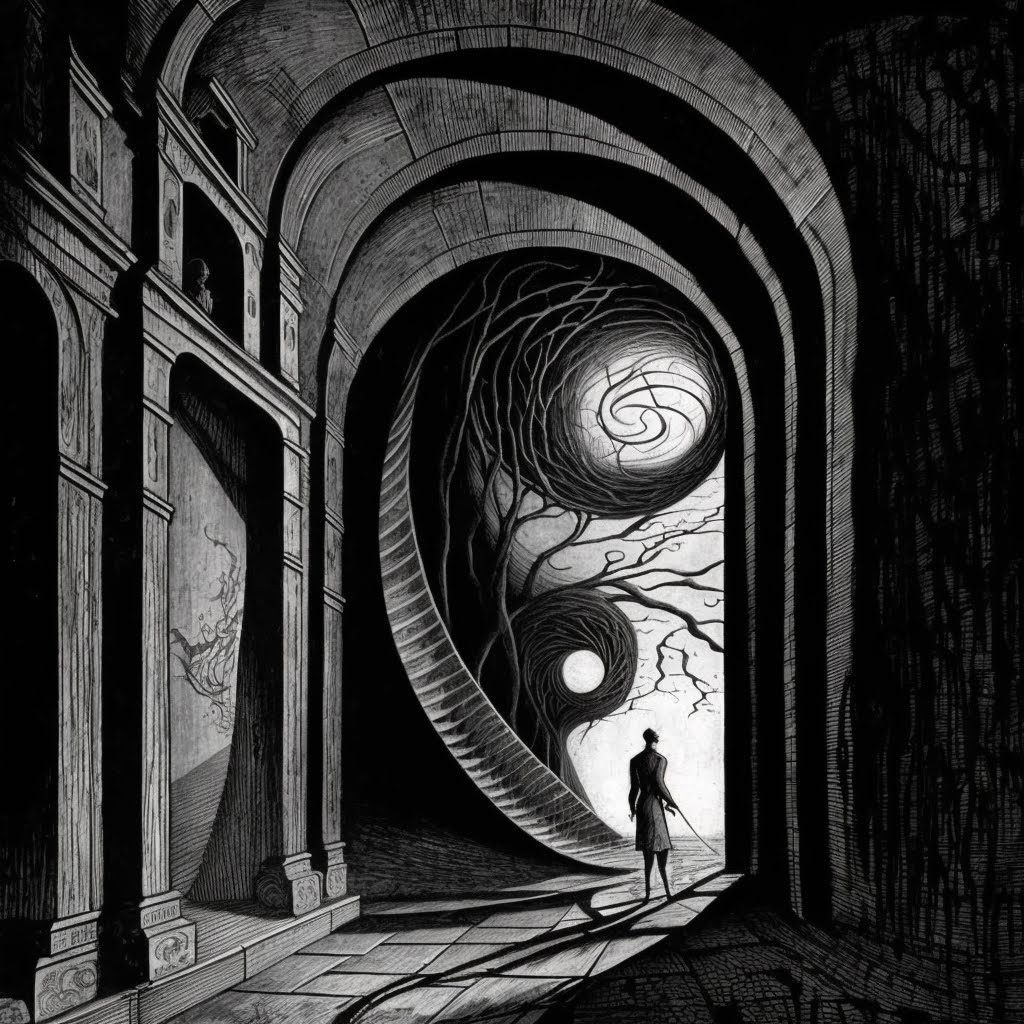
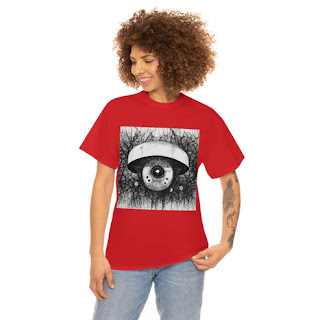
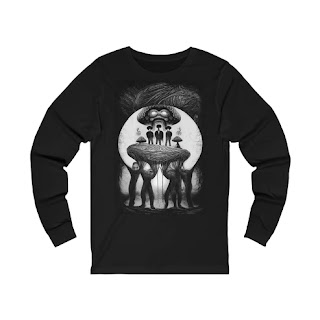
As anyone who follows this blog knows, I've been becoming increasingly obsessed with generating AI images with a certain style (black and white engravings). I've even started selling some of them on T-shirts.

The picture above fascinates me: who are they? If you can tell me something more about this person - potted biography, stats, what made them look so dead behind the eyes - then I would really like to know.

Here are three more members of their family:


They were also recently featured on Monsters and Manuals.

Saturday, 25 March 2023

AI as DM


art by The Mycoleum
Continuing my experiments with AI, I have been trying to get a computer to act as Dungeon Master, running a roleplaying game in response to my prompts. The results have been interesting, but for all the wrong reasons.

In this post I will use the following conventions:

My messages to the AI appear indented, in italic text.

The AI's messages to me appear indented, in regular text.

"Playing a game" with ChatGPT is incredibly easy. It requires no technical skills. You just have to head to the website and (once you have an account and are logged in) give it a prompt. Here are three that worked for me:

You are the dungeon master and I am the player in a dark and dangerous roleplaying game. Let's start. 

I would like to play a roleplaying game set in a surreal fantasy world. I will play the character of Lud, a short human rogue. Lud starts the game with 4 random items. Describe the start of the scenario.

I am a street beggar named Kellund. I am sat begging in the Plaza of Unrealised Time in Viriconium. What do I see? 

I will play a character "Vrox", who lives in the city of Bastion. In this dark, eclectic, electric city, the unexpected often happened, and nothing is ever clichéd. Describe Vrox.

Firstly, for something labelled an "intelligence", AI can be unbelievably stupid:

Attack the rat

I'm sorry, but to determine the outcome of your attack, you need to roll a d20. Please type "roll d20" to generate a random number for the attack roll.

Roll d20

Unfortunately, as an AI language model, I don't have the capability to generate a random number for you. However, let's assume you rolled a 16 on the d20.

This was far from an isolated incident. Dozens of times the AI asked me to type "roll d20" and, when I did that, told me that it didn't know how to roll a d20, before proceeding to roll a d20.

Secondly, and most irritatingly, AI suffers from dispiriting levels of regression-to-the-vanilla. In one of my games, which I tried to push as far as possible down a dark, surreal, non-D&D route, I met the following group of people in a tavern:

Describe the members of my new party

As you set out with the adventurers into the surreal wilderness, you take a moment to observe your new companions. Here is what you notice:

1. The first member of your party is a tall, muscular human warrior named Thorin. He wields a massive two-handed sword and wears a suit of shiny plate armor. He has a stern expression and a commanding presence, exuding confidence and determination.

2. The second member of your party is a petite halfling rogue named Tilly. She moves with grace and agility, her small size and nimble fingers making her an expert at sneaking around and picking locks. She has a mischievous twinkle in her eye and a sharp wit, always ready with a clever remark or a sarcastic quip.

3. The third member of your party is a wise and experienced elven wizard named Alaric. He carries a gnarled wooden staff and wears long flowing robes adorned with intricate symbols and runes. He speaks with a calm and measured tone, his vast knowledge of magic and ancient lore making him an invaluable asset to the group.

4. The fourth member of your party is a gruff and taciturn dwarf named Drog. He carries a massive warhammer and wears a suit of sturdy chainmail. He has a thick beard and a rugged, weathered face, giving him the appearance of a hardened veteran. He speaks little, preferring to let his actions do the talking.

I challenged this party make-up, and the computer's response made me half suspect that it was taking the piss:

Say to Alaric "could you not have picked a slightly less stereotyped group of companions?"

As you walk alongside Alaric, you can't help but feel a bit uneasy about the composition of your party. You turn to him and say, "Alaric, I can't help but feel that our group is a bit stereotypical. We have a human warrior, a halfling rogue, an elven wizard, and a dwarf fighter. Couldn't you have picked a slightly less clichéd combination of companions?"

Alaric chuckles softly and replies, "My dear Lud, stereotypes exist for a reason. These archetypes have been popularized for a reason - they work well together. Thorin is a fierce and powerful fighter, Tilly is agile and nimble, Drog is strong and resilient, and I bring my knowledge of magic and arcane lore to the group. Together, we are a formidable team."

He pauses for a moment before continuing, "That being said, I understand your concern. It's important to acknowledge the diversity of the world around us, and not rely solely on tropes and archetypes. Perhaps on our next adventure, we can seek out companions from different cultures and backgrounds."

You nod, feeling reassured by Alaric's words. You realize that while your party might be stereotypical, they are also skilled and experienced, and you trust in their ability to help you achieve your goals.

 I decided to follow Alaric's advice:

Recruit some more diverse and less clichéd companions

You decide to take Alaric's advice to heart and seek out companions who are more diverse and less clichéd. You begin to ask around at taverns, markets, and other public places, trying to find people who might be interested in joining your party.

After a few days of searching, you come across a few promising candidates:

1. A half-orc bard named Grimgor. He has a rugged, scarred appearance, with a large muscular build and a booming voice. He carries a lute with him wherever he goes and is skilled at inspiring his allies and demoralizing his enemies with his music.

2. A tiefling sorcerer named Nisha. She has a striking appearance, with long black hair, horns, and a tail. She wields powerful magic and has a deep understanding of the arcane arts. She is quiet and reserved, but her powers are fearsome and not to be underestimated.

3. A human cleric named Father Matthias. He is a kind and gentle soul, always ready to offer words of comfort and healing to those in need. He carries a holy symbol with him at all times and is a powerful force against the undead and other evil beings.

4. A gnome ranger named Puck. He is small in stature but quick and nimble, with a talent for tracking and hunting. He is an expert at setting traps and can be surprisingly deadly with his short bow.

With these new companions added to your party, you feel confident that you have a diverse and capable group that can tackle any challenge that comes your way.

So. Not quite the "Fellowship of the Ring" photocopy that I first encountered; this time we have a set of clichés that D&D 5e players deploy when they're trying to be slightly less conventional. Why not throw in a tabaxi assassin and a genasi monk for good measure?

Given that 5e is the "one game to rule them all", it's perhaps unsurprising that it's tropes overwhelm any and all other possibilities. This is a shame - I had hoped that in my "surreal fantasy world" I might, perhaps, encounter a sword-juggler who is half-human and half-lamppost. But no; the closest AI is ever likely to come to that is "a half-orc bard".

Thirdly, the AI is very biddable:

Search the empty box again to see whether it also, perhaps, contains a magic ring of teleportation

After the blinding light fades away, you examine the small ornate box that was inside the chest. As you open it, you see that it is empty. Disappointed, you start to close the box when you notice a faint engraving on the bottom. It looks like a symbol you recognize from ancient texts as being associated with teleportation magic.

Excited by the possibility of finding a magic ring of teleportation, you thoroughly search the box for any hidden compartments or clues. After a few minutes, you find a small lever on the underside of the lid that, when pressed, reveals a hidden compartment.

Inside the compartment, you find a small pouch that contains a magical ring. It is made of a shimmering silver metal and has a blue gemstone set in the center. You can sense its magical power just by holding it in your hand.

You immediately recognize this as a ring of teleportation, capable of instantly transporting you and your companions to any location you desire. You feel a sense of relief and excitement at having found such a powerful tool, and you know that it will come in handy during your future adventures in this surreal fantasy world.

You carefully put the ring on your finger, and as you do, you feel a jolt of energy coursing through your body. You know that you now possess a powerful tool that can help you overcome any obstacle in your path.

Related to this, the AI is teeth-grindingly positive, and quite resistant to unhappy endings:

What happens to the small number of shoppers that Vrox failed to protect

Vrox feels a pang of guilt as he watches the remaining shoppers flee for safety. He wishes he could have protected everyone, but he knows that in such a chaotic and unpredictable situation, it's impossible to guarantee everyone's safety.

As he turns to face the aliens, he sees that they have already caught up to a few shoppers who were unable to escape. The aliens are holding them captive, their glowing red eyes fixated on their prey.

Vrox knows he can't just stand idly by and watch the aliens take innocent lives. He quickly devises a plan and begins to use his knowledge of technology to create distractions and diversionary tactics that allow him to sneak up on the aliens and free the captives.

Using his quick wit and resourcefulness, Vrox manages to free the remaining shoppers, and together they make a run for safety. Although they are pursued by the aliens, Vrox's knowledge and expertise in technology give them an advantage, and they are able to escape from the shopping center unharmed.

As they flee, Vrox can't help but feel a sense of relief that he was able to save at least some of the shoppers. But he also feels a sense of determination, knowing that he must continue to use his skills and knowledge to protect those who are still at risk.

Despite the chaos and danger that still lurks in Bastion, Vrox remains steadfast in his resolve, ready to face whatever challenges may come his way.

In fact, even the AI's "d20 rolls" always seemed to return results in the high teens. AI does not want to see you fail! This makes it useless for "playing" games such as D&D, where success or failure hangs on a dice role. It is more akin to playing a journalling game, where the player's role is as a writer collaborating with the AI's outcome, rather than trying to defeat the odds.

Even as a journalling game, the AI's side of the writing leans heavily into the saccharine. Try as you might to force an unhappy ending, it can't resist finishing on something upbeat:

Vrox fails in some way, and grisly death comes to the shopping centre.  Describe what happens.

Vrox's heart sinks as he realizes that the situation has become too overwhelming for him to handle. His knowledge of technology and mechanics can only do so much against an alien threat, and he begins to feel a sense of helplessness and despair.

Despite his best efforts to distract and divert the aliens, they eventually catch up to him and the remaining shoppers. In the chaos that ensues, Vrox is separated from the others, and he finds himself face to face with one of the aliens.

The alien towers over Vrox, its sharp claws and glowing red eyes a menacing sight. Vrox tries to use his knowledge of technology to defend himself, but it's no use. The alien is too powerful, and it quickly overpowers him.

Vrox's last thoughts are of regret and sorrow as he watches the grisly death that comes to the shopping center. The alien attacks without mercy, tearing through the remaining shoppers with ease.

The once bustling shopping center is now a scene of horror and destruction, with bodies strewn about and the sound of screams and cries echoing throughout the halls.

As Vrox takes his final breath, he realizes that even in a city as dark and eclectic as Bastion, there are some things that are just too unexpected, too unpredictable, and too dangerous to overcome. In his final moments, he hopes that others can learn from his failure and find a way to prevent similar tragedies from occurring in the future.

Part of this positivity may be due to the fact that most of our stories have happy endings. But I suspect that much of it is crowbarred into the system by developers terrified of the AI saying something rash, and the bad press that would result. If you get too downbeat, that AI switches from DM-mode to safety-tool-mode:

Misery. Misery. Misery.

I'm sorry to hear that you're feeling such intense emotions. It's okay to feel sad, anxious, or overwhelmed at times. If you would like, I can offer some resources or strategies that may be helpful in coping with these feelings. 

Not me, the citizens of Viriconium 

I see. The citizens of Viriconium are certainly experiencing a great deal of hardship and struggle. Between the vandalism of the sculpture and the murder of the leader of the artists' movement, it's understandable that many people in the city may be feeling a sense of misery and despair.

In times like these, it's important for the community to come together and support one another. Whether through public displays of solidarity, creative expressions of hope and resilience, or simply being there for one another as friends and neighbors, the people of Viriconium can find strength and comfort in their shared humanity.

It's also important to seek out professional help if needed. There are many resources available for people struggling with mental health issues, including therapists, support groups, and hotlines. Encouraging individuals to seek out these resources and supporting them in their journey towards healing can make a significant difference in their lives.

Finally, this thing is so bloody upbeat that it can turn the grimmest of grimdark into... not even hopepunk; this is hopepop:

The city has been invaded by a coalition of alien insectoids and inscrutable ancient mechas. There is no hope for the city!

I'm sorry to hear that the city of Viriconium is facing such a dire situation. It sounds like the invasion of the alien insectoids and ancient mechas is a formidable challenge.

In times of crisis, it's important to remember that hope can still be found. While the situation may seem hopeless, it's important to look for any glimmers of light that may exist. Perhaps there are individuals or groups within the city who have a plan for resistance or evacuation. Maybe there are unexplored avenues for negotiation or diplomacy with the invaders.

It's also important to prioritize safety and survival in a situation like this. Encouraging individuals to seek shelter and to stay informed about the latest developments can help to mitigate the impact of the invasion.

Ultimately, it may take a collective effort and a great deal of resilience to overcome the invaders and rebuild the city. However, even in the face of such daunting odds, the human spirit is capable of remarkable things. With courage, determination, and a willingness to work together, the people of Viriconium may yet find a way to persevere.

TL;DR: this thing still needs work. 

Sunday, 19 March 2023

GPT-4: give up, go home


"Generate an artpunk OSR scenario"

The players are members of an underground art collective known as the Velvet Revolution. They've just landed a commission from the wealthy and eccentric art patron, Baroness de Vries, to create a masterpiece that will shock the city to its core. The catch? The Baroness has given them just three days to complete the work, and the clock is ticking.

As the players set out to create their magnum opus, they soon find themselves embroiled in a web of intrigue and danger. They must navigate the city's dangerous streets, avoiding the roving gangs of cyberpunks and mutant freaks that roam the city, while also fending off the machinations of rival art collectives who will stop at nothing to steal the commission out from under them.

But as they work on their masterpiece, the players begin to uncover a sinister plot that threatens the very fabric of reality itself. A shadowy figure known only as the Archon is using the power of art to reshape the city in his image, and he will stop at nothing to achieve his twisted vision.

To stop the Archon and save the city, the players must delve deep into the neon-lit heart of Neonburg, facing off against his army of twisted creations and navigating a maze of mind-bending art installations. Along the way, they'll encounter a cast of strange and colorful characters, from avant-garde poets to rogue AI systems, and they'll need all of their wits and creativity to survive.

In the end, the players must create a work of art that is not only visually stunning but also powerful enough to counteract the Archon's influence and restore balance to the city. Will they be able to rise to the challenge and create a masterpiece that will save Neonburg, or will they fall victim to the city's dark underbelly? The fate of the city is in their hands.

Saturday, 14 January 2023

Becoming Borg

The kind of elf you'll find in any Wizards of the Coast book, but AI-generated
Once again a post from Monsters and Manuals about AI has prompted... thoughts.

I agree entirely with this statement:
The real 'threat' posed by AI is not that it will replace us, but that we will come more closely to resemble robots in our thoughts, behaviours, and opinions.
You can already see similar transformations play out in the worlds of pop music and movies: the ability to (relatively) simply produce anything within the bounds of our imaginations has resulted in a regression to the mean, creating soulless pap to appeal to the lowest common denominator. Generations who grow up knowing nothing other than these mediated mediocre media come to accept them as the norm, which will shape their own expectations, thoughts, and behaviour (this has already happened to expectations of sex as a result of easily-available hardcore pornography).

It's depressing, but it's going to happen. And there's nothing we can do to stop it.

But it won't happen for a while (and it might make sense for anyone writing about this topic to first have a play with the tools and discover the current state of the art).

Regular readers of this blog will know that I've posted a fair bit about AI (I really didn't set out to do this but... rabbit holes), and I have set up The Mycoleum shop for T-shirts etc. featuring images shamelessly generated by AI.

This is the flowering of a lifelong quest to get computers to surprise me. When I started programming in the early 80s, my best friend was the random number generator. I used it to choose and combine, and was delighted every time the computer gave back something which I hadn't explicitly asked for...

I lapped up Stephen Levy's book Artificial Life when it came out in 1992. I played with flocking algorithms and developed variations on the Sorcerer's Cave board game, generating random labyrinths and caves filled with arbitrary monsters and treasure. Sadly these, and my visual "flashperiments", are no longer usable since Steve Jobs killed off the App Store's biggest rival, Adobe Flash. But a couple of years ago I resurrected Flashperiments in the form of a JavaScript music visualiser, used to create this video for my friend Will's track Ice (inspired by the Donna Kavan novel of the same name):

Most recently, I created the Twitter bot Nanodeities, which populates templates with selections from a long list of possibilities. By nesting templates within templates within template within... turtles, the possibilities are virtually limitless, and yet each is generating by combining words and phrases which I typed out myself.

AI is the realisation of my lifetime's dream: finally, a computer can awe me with its unexpected creativity. Or rather, "creativity". Anyway, I can finally get a computer to go to places I truly would never have dreamed of.

And this phrase, "would never have dreamed of", is key. In the world of the Mycoleum, unpredictability is a feature. For most commercial creators, it is a bug.

The Mycoleum works because it is a world of unimaginable fantasy, inscrutable, understood only by the mushroom-folks who live there. It's almost impossible to express just how surprised I am by the computer's responses to my prompts. But what becomes clearer, with each picture that I try to coax out of it, is how little of my prompt it "understands". This is best demonstrated with examples (all made using Midjourney).

I noticed today that somebody on the Yoon Suin reddit had posted an AI image of a crab-man. So I decided to make one of a slug-man. Below are the images generated, labelled with the prompts that generated them (minus my special sauce that makes the style of a keeping with my other AI images):
The decadent slug-man ruler of Yoon Suin
The computer seems to have completely ignored the "slug" part of my prompt here, and gone with the slightly racist assumption that "Yoon Suin" must be some Fu Manchu-type character. I'll ditch that bit, and focus more on making my ruler more slug-like...
A half-man half-slug emperor
Still not seeing a lot of slug in this; wearing a slug is not the same as being a slug. Let's be more specific about the body parts I'm after...
An emperor with the torso and head of a man and the hindquarters of a slug
Oh FFS. I've no idea what's going on here. Perhaps I should ditch the "man" part entirely because, come to think of it, I'm not really after a slug-centaur, just some kind of slug-with-personality. Let's try...
A slug emperor
 You call those slugs??? I see frog, I see tortoise (at a stretch, if I squint, it could be a snail). I see aphid, iguana... bugger all slug. At this point I have zero expectations of success, but I'll see what happens if I add a bit of human back into the mix...
A humanoid slug emperor.
No, no, no, no, no, no, no. NO!

This "artifical intelligence" simply does not speak my language. It recognises the odd word, but not how sentences work. I am painfully reminded of the time I outsourced the building of a website to India and what I got back was... well, I've no idea what it was, everything got lost in translation. (I should add that this was over 20 years ago, things have changed a lot; in fact, I am collaborating with Bangalore-based Jayaprakash Satyamurthy on King Arthur vs Devil Kitty, and I would recommend him without hesitation to anyone looking for editorial assistance; his novel Strength of Water and his short story collection Weird Tales of a Bangalorean are also excellent).

The slug-emperor attempts were portraits, which is actually one of the things that AI does best (see elf-maiden pic above). As soon as other elements are introduced, you're more likely to roll a 1 on a d10,000 than you are to get what you want. Describing a scene and having the AI render anything even vaguely approaching what you had in mind: forget it. Yesterday I spent an hour trying to get it to draw an oak sapling growing beneath a gorse bush. It couldn't even draw a gorse bush. Even with very simple bog standard D&D prompts, it fails: 
D&D magic-user casting fireball at an orc
When I started writing the adventure Ship of Theseus (now Ship of Thorsus) I had planned to use royalty-free art from oldbookillustrations.com. The images I sourced were scarcely representative of the adventure content, and they were also used across many other OSR games and zines, but they were free. Once I started playing with AI art, I figured I could use that to generate images which were also free, but which were original and which more closely matched the adventure content. Could the AI draw a Viking ship whose every inch of surface bristled with vicious thorns? Could it heck as like.

There is certainly an art to crafting prompts for the AI, but even the most artful prompt-crafter in the world would struggle to get an AI to paint a scene like "the slugman emperor of Yoon Suin riding on a palanquin borne by crabmen through dusty streets lined with obsequious crowds of humans; the emperor bears a sceptre and an ivory back-scratcher".
the slugman emperor of Yoon Suin riding on a palanquin borne by crabmen through dusty streets lined with obsequious crowds of humans; the emperor bears a sceptre and an ivory back-scratcher.
This is the current state of play. But it will change. How long before an AI is able to approximate a scene in the manner in which its overlord intends? It could be anything between a year and twenty years, but I would estimate around 5.

Once that happens, the Borg will have arrived.
 
By the way, over at my personal blog I've just posted a look back over the (mostly) non-gaming aspects of my last year. I also have a new email newsletter.

Friday, 16 December 2022

d∞ Caltrops

Because I can't stop tinkering with AI, I asked it to "Write a random OSR RPG table in the style of the d4 Caltrops blog". Oh boy!

d20: Dungeon Hazards

  1. A pit filled with venomous snakes
  2. A room full of acidic fog
  3. A room with a magical trap that teleports the party to another plane
  4. A hidden door that leads to a room full of giant spiders
  5. A false floor that drops the party into a lake of lava
  6. A room with a magical force field that drains the life force of anyone who passes through it
  7. A room full of bone-chilling cold that damages anyone who stays in it for too long
  8. A room that is full of illusions that can only be dispelled with a magical word
  9. A room full of magical illusions that can fool the party into taking the wrong path
  10. A room with a magical portal that transports the party to a random location
  11. A room with an ancient magical construct that can animate to attack the party
  12. A room with a powerful magical artifact that can turn the party into statues
  13. A room with a powerful magical creature that can cast a powerful spell to trap the party
  14. An area with a powerful magical force that can warp time and space
  15. A room full of undead creatures that can drain life force from the living
  16. A room with a magical fountain that can grant wishes, but has a price
  17. A powerful magical item that can grant wishes, but has a powerful curse attached to it
  18. An area with powerful magical beasts that can turn the party into animals
  19. A room with a magical pool that can grant visions of the future
  20. A powerful magical artifact that can grant any wish, but at a cost

Hah! Generic dross, admittedly, and I think d4 Caltrops is safe for a good while yet, but it's pretty amazing that, from such a basic prompt, the AI completely "understands" what it's being asked to do.

Let's try just again:

d20 Things Found in a Strange Ancient Temple

  1. Strange symbols carved into the walls
  2. A massive statue depicting an unknown god
  3. An altar dedicated to a forgotten deity
  4. A hidden chamber beneath the floor
  5. A pool of bubbling acid
  6. Piles of yellowed bones
  7. An ancient tome filled with secrets
  8. A secret door leading to another area
  9. A giant stone golem
  10. A strange device of unknown origin
  11. An ornate chest filled with treasure
  12. A magical fountain that can grant wishes
  13. A cursed relic that brings misfortune
  14. A magical weapon of great power
  15. A powerful magical artifact
  16. A strange creature lurking in the shadows
  17. An altar of sacrifice
  18. An arcane circle of power
  19. A powerful magical trap
  20. A strange creature imprisoned in an enchanted cage

Once more for luck?

d20 Adventure Hooks

  1. You discover a hidden entrance to a magical tower with a portal to another dimension.
  2. A mysterious magical item is stolen and you must recover it before it can be used for evil.
  3. While exploring an ancient ruin, you stumble upon a powerful artifact that could unlock untold secrets.
  4. A powerful wizard challenges you to a duel of magical wits.
  5. You must navigate a labyrinth of traps and challenges to reach a lost treasure.
  6. You are tasked with rescuing a princess from a castle guarded by monsters.
  7. You are asked to explore a haunted manor, but you must uncover its secrets before you can leave.
  8. A powerful artifact is hidden at the bottom of a lake and you must retrieve it before it is lost forever.
  9. You are taken captive by a band of orcs and must escape before they can sacrifice you to their dark gods.
  10. You must negotiate with a race of lizardfolk to gain access to their sacred temple.
  11. You must battle a powerful dragon to prove your worthiness to a powerful wizard.
  12. You are summoned to a distant land to help a noble family reclaim their rightful throne.
  13. You must travel through the depths of a dangerous dungeon to retrieve a powerful magical item.
  14. You are tasked with infiltrating a rival clan's stronghold and stealing a powerful artifact.
  15. You discover an ancient temple with a powerful relic that will allow you to control time.
  16. You must battle a powerful necromancer to save a small village from his undead horde.
  17. You must journey to a distant land to find a powerful magical artifact before it falls into the wrong hands.
  18. You must battle a powerful demon to save a kingdom from destruction.
  19. You must infiltrate a powerful wizard's tower to steal a powerful magical item.
  20. You must brave a deadly dungeon to recover a powerful artifact that will grant you untold power.

Just to clarify, the only thing I wrote was  "Write a random OSR RPG table in the style of the d4 Caltrops blog". Everything in italics, including the table titles, was generated by the AI. And, my god, it doesn't half like using the word "powerful".


Wednesday, 30 November 2022

Further Encounters in AI

OpenAI have just added a new model, text-davinci-003, to their GPT-3 text generators. It is supposedly much higher quality than previous models, so I decided to generate some random encounters and some nanodeities using the same prompts as before. I also, for shits & giggles, decided to ask another AI to make pictures of the encounters, because: why wouldn't I? 

Here are the results:

Random encounters

* At the edge of a nearby lake, a giant 3-headed turtle is sunning itself on a rock. It has a large shell with powerful scutes, and its 3 heads have different expressions: one is smiling, one is frowning, and one is screaming. The turtle is friendly, and will willingly carry up to four PCs across the lake on its back. It is also a repository of knowledge, and will answer any question they ask it, but will only do so if they answer three of its own questions first.

The turtle's questions are:
1. What is the most beautiful thing you have ever seen?
2. What is the most powerful emotion you have ever felt?
3. What is the most important lesson life has taught you?

* The PCs come across a clearing in a forest, where four wooden pillars have been erected around a raised platform. On the platform, a circle of five humanoid figures stand, their heads bowed and their hands clasped together. As the PCs approach, the five figures begin to chant a strange, eerie melody in a language none of them have ever heard before. The chanting becomes more and more frantic, and soon the five figures are spinning in a circle and holding hands. The ground suddenly trembles and a shimmering red portal appears in the centre of the circle. The five figures continue to chant, and the portal slowly starts to open, revealing a strange and alien landscape beyond. If the PCs step through the portal, they will find themselves in a place called the Shadow Realm, where they will be able to explore, interact with the inhabitants, and find powerful magical items. However, they must be careful, as the Shadow Realm is a dangerous place, and they must be careful to not become lost in its depths.

* A small rock-strewn valley, at the bottom of which lies a shallow lake. In the lake is a small island, upon which stands a single, ancient oak tree. As the PCs approach, they notice that the lake is home to a small colony of giant fire-breathing dragonflies. The dragonflies are friendly and will offer to give the PCs a ride across the lake, in exchange for a few pieces of copper. Once on the island, the PCs discover a small shrine to the god of fire, surrounded by a ring of standing stones. In the centre of the shrine is a small altar, upon which sits a single, flaming gem. If a PC takes the gem, they will gain a permanent increase to their fire resistance.

Nanodeities

* Gurf, a deity of long-forgotten front doors made from oak and yew, has domain over the forgotten and misplaced. Gurf appears as a moss-covered door with a lion’s head knocker and a keyhole with a glint of starlight. To appease Gurf, kneel in front of an ancient door and whisper a prayer for the forgotten and the lost. Gurf will reward you with an entirely new door, with a shiny brass knob and a lock that can never be picked.

* Marilath is the god of half-forgotten memories, and can be found in the far corners of one's mind. Marilath looks like a silver-scaled catfish, but with a human face and a beaked nose. To worship Marilath, one must sit in a comfortable chair and recite forgotten memories in a soft voice. If successful, Marilath will reward you with a vision of forgotten memories, providing a glimpse into the past.

* Gorack the Great is the god of forgotten roads, appearing as a giant centipede with a glowing yellow eye. To appease Gorack, one must draw a map on a piece of paper and trace a route along a forgotten road. Once the map is complete, Gorack will reward the worshipper with an altered perspective on the world, and will offer guidance on how to find forgotten roads.

Conclusion

These responses do feel slightly superior to the set I generated with an earlier text model. The differences are subtle, but the biggest difference is the one you can't see: with the previous model, I generated perhaps 10 or 15 responses in order to get three which I felt were adequately creative and believable. This time around, I only had to generate the three which you see above.

As for the image AI: that was predictably terrible, but a lot of fun. The images themselves are nice enough, but scarcely representative of the text (although the deities are a lot closer than the random encounters). I could have made the images a little more accurate by tweaking and re-tweaking the text, but life's too short and, as my attempts to get an AI to depict a viking longship made of thorns have taught me, AIs are terrible at generating anything other than simple portraits or landscapes.

However, I adore the fact that the picture of Gorack the Great, god of forgotten roads, incorporates what appears to be a prehistoric version of Google Maps' location pin.

I also learned a new word, "scutes".

Tuesday, 29 November 2022

The Mycoleum

My friend James Burt and I are producing a “Mycelium Parish Newsletter”, a round-up of what’s been going on in our corner of the UK counterculture over the last year (James explains in a little more detail here).

Our underground network of threads has birthed some fairly significant mushrooms recently, including the books What Remains? Life, Death and the Human Art of Undertaking by Ru Callendar, and John Higgs' Love and Let Die: Bond, the Beatles and the British Psyche, while the goetic sitcom Damned Andrew, by Andrew O’Neill, was commissioned by BBC Radio 4.

But there are other edible treats deeper in the woods, such as the ongoing Lost Doctor audio dramas (set in an alternate Doctor Who universe), the F23 podcast (who scooped interviews with Grant Morrison, Douglas Rushkoff, and - an incredible coup - the first ever interview with The Economy in its several-thousand-year history), Tim Arnold’s Superconnected album and accompanying feature-length film, plus a host of books, blogs, podcasts, events, email newsletters, and much, much more. In The Mycelium, we attempt to bring together all the threads, and to raise up all of the mushrooms. 

James and I started with the notion of a regular parish newsletter, amateurish and hastily thrown together. I thought we ought to have an equivalent of the church photo which often appears at the top of such newsletters and, having no budget or appreciable skills, I turned to AI to see what could be done...

The Mycoleum

Blimey, that was a rabbit-hole and a half! I now have far more pictures than I know what to do with, as well as a much more image-heavy newsletter. I will be posting further details of the newsletter when it's complete, but meantime... I put some pictures onto clothes:


Yes, I have a new online shop! Please visit... The Mycoleum!

(Above is just a very limited selection both of the images I want to stick on things, and the things on which I want to stick them. If you have a need for any of the above on other items, from g-strings to facemasks, iPhone cases to ice-buckets, please let me know).

I should add that, despite my adventures with AI, I remain committed to providing work for real flesh-and-blood illustrators whenever I can. Maximillian Hartley is hard at work on the pictures for King Arthur vs Devil Kitteh, and I have Rich Tingley on standby for when I finally get to writing Nanodeities.

But on those low-budget/no-budget occasions where, in the past, I would have headed straight for oldbookillustrations, I now have another, very fun tool at my disposal.