 |
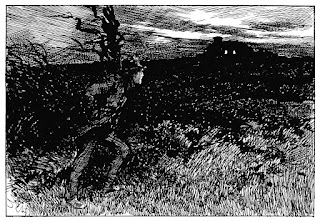
| A Light in the Pavilion by Gordon Browne |
This is the first of a few posts I'll be writing about play-by-post RPGs (formerly known as play-by-mail - PBM - and then play-by-email - PBeM). I played in quite a few PBM games in the 80s, and have been thinking about running one myself for quite some time now (using rules loosely based on
Monte Cook's Cypher system). But first, an example of how such play might go...
Let's say that at the end of your last turn, you decided to leave town and head for a distant pass over the top of the moors. here is how the GM might describe what happens next:
You follow the cobbled road out of the village, passing farms and other buildings on either side. After about a mile you pass an inn, and a goods yard. The farms continue for another a mile or two, although this far out they are smaller and further apart. After this, the road starts to rise, and the valley closes in on either side. The sides of the road become increasingly wooded, with sessile oak, silver birch, rowan, and holly. There are fewer signs of other travellers up here: the cobbles are less worn, and there is very little mud and hay left by passing vehicles. The weather becomes noticeably colder, and there is a musty, mossy smell from the woods.
You continue up the valley. Along the way, you find a pleasing pebble, about 3 inches by 1 inch, made of a material you’ve never seen before. You play with it in your hand while walking; it is smooth and lovely. Eventually you pocket it.
After a couple of hours you reach a small hamlet inside a high wooden stockade. The road goes through the settlement, turning sharply to the left, but before this is a steep pony track that climbs the far side of the valley, through the woods, in the direction that you were already walking. You avoid the hamlet and take this track. The cobbles are replaced with mud and rocks, it’s a much steeper and slower climb than the road, and the woodland smells are augmented with notes of peat and heather.
Ten minutes in, there is a tree trunk blocking the path. You go to climb over it…
Climbing over the tree trunk is fairly, but not entirely, straightforward. It’s a Difficulty 1 task, so you need to roll a 3 or higher to succeed. You roll… 16! You leap over the trunk in a single bound.
In just under an hour, the path reaches the plateau of the moor where the woods thin out, with just scattered individual birch and hawthorn trees in front of you. There is a bracing wind, flattening the cotton-grass. You look behind you and see the stockaded village and the valley, stretching out way below you. Ahead and to either side you see undulating moorland, with peaks in the distance in all directions.
After another mile of slow going, weaving through marshes and heather beds, as the sky is darkening you see the lit windows of a small stone house in a hollow in the distance. This is the first dwelling that you have seen since leaving the main road, and it appears totally isolated. There is smoke coming from the chimney.
You gain 1XP this turn for exploring the area up the valley and onto the moorland..
What do you do next?
Having read that, you send in the instructions for your next turn:
I will pick a sprig of lucky heather, wear it in my buttonhole, and cautiously but very openly approach the house. When I’m near, I will shout “hello? Is there anybody there”. If anyone comes out then I will greet them and try to speak to them about local affairs, the weather, and what to expect on the path ahead. I’ll use 1 Level of Effort to try and make them like me. If they’re really friendly I would like to stop off for a meal and perhaps to stay the night. I’ll also ask politely whether they have any rations I could take with me for my next day’s hike, offering to do a little work for them in return.
If they are hostile, I will firstly try to calm the situation: “I’m just a simple traveller, visiting my cousins on the far side of the moor, I mean you no harm and will be on my way now”. If that doesn’t placate them, I won’t attack first but I will be prepared to defend myself, and will expend 1 Level of Effort both defending and attacking, as I’m all alone up here and they probably know the terrain better than me. If things get really bad, I will use up the invisibility Cypher on my cloak to hide, and then sneak away from here.
When I’m done here, I’ll carry along the path, as described in my last set of instructions. Hopefully I can still make it to another house or a hamlet on the other side of the moor, but if not then I will find somewhere sheltered, wrap myself in furs, and catch 4 or 5 hours’ Rest. I won’t light a fire for fear of attracting any creatures up here.
The GM reads your instructions, and tells you what happens next:
You walk cautiously over the half a mile to the house. Your movements are slower and more exaggerated than usual, and you keep a close eye on the house all the time for signs of movement.
When you're about 50 feet from the house you call cautiously "hello? Is there anyone there?". There is no reply. You walk a few feet further, and in a louder voice call “hello? I'm just passing through, I was wondering whether I could do some work for you in exchange for food?”
You hear a banging sound of wood on wood, coming from inside the house. The door swings open and an elderly man dressed in in worn, brown felt clothing steps out. He has a white beard and a bald head, but looks tanned and healthy from his moorland life.
Normally, convincing a person like this that you are friendly would be a Difficulty 3 task. However, he is lonely, which reduces the difficulty to 2. Your training in conversation reduces it further to 1. And the Effort you expended reduces it by one further, to zero. You don’t have to roll to succeed, but I’ll do it anyway to see how well you get on with him - a 19! He welcomes you like a long-lost child. But the Effort you expended means you must take 3 off your Intellect score until you next rest.
“Hello” he says heartily, “I’m Norhelm. Food, did you say? Well I'm sure I could rustle something up for you, it’s not often that I see visitors up here. Come on inside!”
You accept the invitation and go into the house. Inside, it appears even smaller than it did from the outside. Just one room, cluttered up with peat-cutting and farming tools, plus various junk and chunks of uncut stone. There is a string hammock strung over the lot of them, grey furs heaped inside it. There’s only one seat and Norhelm offers it to you. He fills a pan with water and puts it on the stove, then turns to talk to you. "So, you'll have just come up from the valley? That’s quite a climb.” You tell him that actually you've come all the way from Hope, at the far end of the Valley. “Oh, ho ho, very cosmopolitan then!”
You begin to describe your journey to him, then remember the pebble that you found and, feeling that the old hermit is trustworthy, show it to him. He accepts it from you, turns it over in his hands, and says "yes, I've seen ones like these before. They’re more common over to the west, on the far side of the Peaks.” Inspecting this one further, he points out that it has a Cypher on it which, when used, will give you protection equivalent to heavy armour that lasts for one minute. He hands the pebble back to you.
He cooks up a simple meal of beans and onions. The warm, humid smell of the food fills the hut, putting you at your ease and making you very hungry after all your exertion. You both sit down to eat. It's hard for you to get a word in edgeways, it seems like he hasn't talked to anyone for a long time, and now he's making up for it. He tells you about life up here on the moor, about the seasons and the few scrawny crops he grows in his garden, the sheep he used to let roam the surrounding moor. He tells you that he's been bothered lately by some "inhumans" (this is a term you've heard before: it’s used to refer to the early hominid races who survive in small numbers in this area. They live only in secluded places. It seems from what you’ve heard that there are various different races of inhumans, some living on the moors, some in the woods, and some underground).
Your time in the house counts as a Rest. You regain the 3 Intellect points that you used to befriend the man.
You ask him what these creatures have been doing to him, and he replies “destroying my crops, stealing sheep from me—I have to keep them penned in now, and it’s causing them stress. Twice those monsters even came close to the house and seemed to threaten me, I don’t know what language they speak but I’m sure they weren’t inviting me over for a meal.”
GM Intrusion - the following event is something thrown in by the GM to spice things up. You can Refuse a GM Intrusion, but doing so costs you 1XP. If you accept the GM Intrusion, you immediately gain 1XP (and if you are journeying together with other characters, you also get 1XP to give to one of them).
At this point you hear a banging at the door. Norhelm suddenly looks alert. "Them!" he says. He moves swiftly to the side of the door, grabbing a kitchen knife on the way, and indicates that you should move to the other side of the door.
You gain 1XP for your conversation with Norhelm. If you accept the GM Intrusion, you gain another XP. If you reject it, you lose the 1XP that you gained this turn.
Do you accept the GM Intrusion? Either way, what do you do next?
And your instructions...
Firstly, I accept the GM Intrusion. But if there’s a fight, and I’m guessing there will be, I’ll spend that 1XP to re-roll any failed Defence attempt once my Might drops below 3.
I’ll move to the door as Norhelm suggested. I’ll follow his lead, but be prepared to attack with my dagger. If there are three or more things out there, I’ll try to knock one over first. I’ll apply Effort to that, and to all my attack rolls until my Might drops below 6. And the invisibility Cypher might still come in handy if the going gets really bad...
As you can see, the replies are quite long, and the GM has quite a lot of leeway in them to interpret the player's instructions, and make decisions on their behalf. This is something I'll be coming to in future posts. In the meantime, I'd love to hear your thoughts... would you be interested in playing something like this?