 |
| some good books |
Over on t'other place I've just posted a list of my favourite books of 2022.
|
| some good books |
Over on t'other place I've just posted a list of my favourite books of 2022.
 |
COMING SOON FROM PEAKRILL PRESS... |
This is a genuine medieval tale, and it's about the daftest thing we've read in a long time. We're almost certain that large parts of the film Monty Python and the Holy Grail were based upon it. It was first written down (in French) before the year 1250 CE, when it appeared within "The Old French Vulgate Cycle", and was translated into English as part of what is now know as "The Prose Merlin" around 1450 CE. Since then, it's become remarkably obscure (Monty Python aside), and we feel that its time it was unearthed again. And so, we're turning it into a beautiful illustrated book.
 |
| Arthur and Merlin unite Albion |
.jpg) |
| Arthur and Merlin arrive in Europe |
Of course, for fans of tabletop roleplaying games, we will wow you with the Stats of the Cat, a playable monster with skills and weaknesses the likes of which you've never seen before. Add Devil Kitteh to your game of D&D or Into The Odd, and your players will never complain about losing a limb ever again.
Who knows, perhaps one day we will make it a movie. One that wears its sources a little bit more up-front than that Holy Grail of 70s' cinema.
To be kept up-to-date on the progress of this project, please sign up at the Kickstarter site for the book. This does not in any way commit you to backing it or buying a copy when it launches, it's just the best way for us to let you know when it's ready to launch.
 |
| Initial concept sketches |

I interviewed noisms, who blogs as Monsters and Manuals, publishes noisms games, and is best known for his fantasy game setting Yoon Suin, the Purple Land. Right now he'a running a Kickstarter for The Corridor of the Seventh Green Magic User The Hall of the Third Blue Wizard, a zine featuring high-quality commissioned RPG modules and short stories. Although I fucking hate acronyms, for sanity's sake I'm sure I'll be referring to it as THOTTBW or THotTBW or THot3■W by the end of this post, however dirty that makes me feel.
Here are audio and video versions of the interview, and below them are a summary of what we talked about with LOTS of notes and links and other good stuff.
 | ||
| Woods and Dark Animals by Sidney H Sime |
Inasmuch as there is a Peakrill Press house style, it is that of fin-de-siecle fantasy-inspired illustrations of the late 19th and early 20th century (largely nicked from oldbookillustrations.com); images by Arthur Rackham, Aubrey Beardsley and, especially, Sidney Herbert Sime.
I love this style of drawing, and the worlds it depicts; lands of fairies & strangeness from a time when fantasy was not yet smothered in Tolkienesque tropes. I associate it with the purple prose of writers like Clark Ashton Smith and Lord Dunsany (Sidney H Sime had a close association with Dunsany, producing illustrations for many of his books).
[Incidentally, the short story collection Appendix N, The Eldritch Roots of Dungeons & Dragons, edited by Peter Bebergal, is a great starting place for exploring this type of fantasy-without-orcs: it's what got me back into reading fantasy prose after shunning it for about 30 years]
The success of the Kickstarter for Rackham Vale, a game based on the works of Arthur Rackham, got me thinking about Syme again. Would it be possible to do something similar with the his work? Where would you even start? I would start with Bogey Beasts.
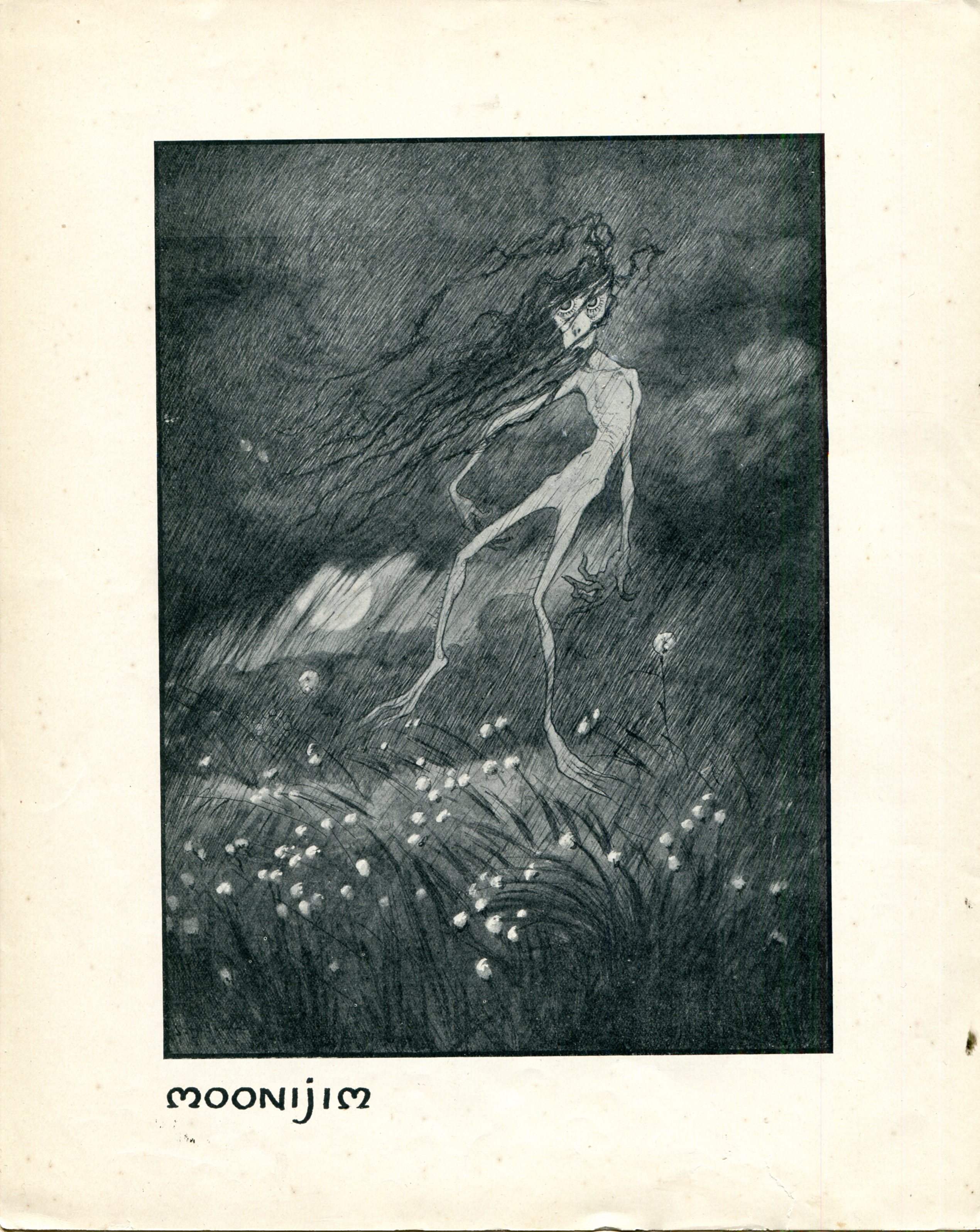

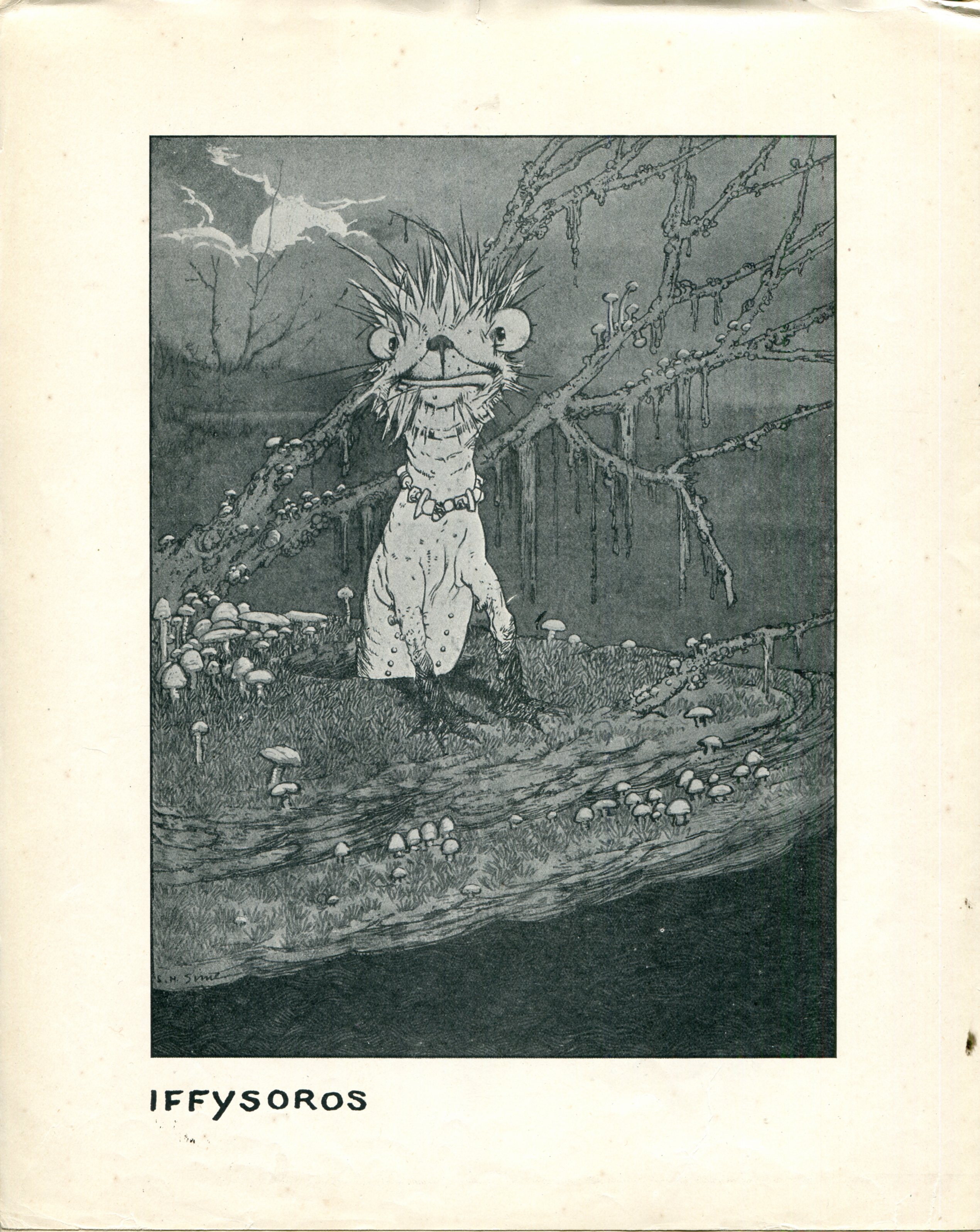
Bogey Beasts is a 1923 book of illustrations with accompanying poems, both by Syme. I've had a copy since I was a kid - it is perhaps my favourite book ever. I was a bit gobsmacked to see that the book now sells for around £1,000, though my heavily-loved copy would fetch a lot less and is, anyway, priceless.
[I'm not sure where my copy came from, but I suspect it was a choice pick from "jumbling", our annual January ritual, long nights spent ringing at doorbells and collecting people's unwanted clothes, books and junk, to be sold at the Woodcraft Folk jumble sale. It seems a strange idea now: sending kids out solo to call at strangers' houses, begging. But collecting and then sorting jumble was a highlight of my year, though I could have done without the dust mites]
The book also contains music for each beast, composed by Josef Holbrooke. I spent many hours trying to code this music into my BBC Micro, but the polyphony of the pieces defeated the computer's primitive synthesiser. It wasn't until a few years ago that I first heard the music, in this video:
The bogeyest of all the beasts, the dark lord of the deeps, nightmare-giver and dream-inhabitor, was The Snide:


Of course, childhood me converted the Snide into a D&D monster:


I've been revisiting Bogey Beasts recently. Dark wells of childhood dreams. I'm finally old enough to appreciate the poetry, not just the pictures, and it stands up pretty well - pisses all over the poems of Clark Ashton Smith, IMO.
I am tentatively working on a ghost-forest setting, and Syme's dark landscapes, punctuated with flowers that are almost absences, is how this forest looks inside my mind:

I won't be writing up a Rackham Vale-style game world any time soon but, who knows, if you find yourself deep, deep, deep in an undersea cave, somewhere in my game world, you may find yourself running into a Snide.


 |
| Viriconium comic, in German, by Dieter Judt |
Deep in work-work and in lieu of anything new to say, I'm rehashing this passage from my personal blog.
When I discovered the OSR 18 months ago, it surprised and pleased me to discover how much influence M John Harrison (or at least his Viriconium sequence) seemed to have over the movement. Mike Harrison's writing has significantly altered my views on literature at least twice in my life.
Ironically, I seem to remember Mike once mentioning that he'd heard people were roleplaying a version of Viriconium; he was perplexed as to why and how. At the time I understood that Viriconium was a tricksy illusion, only meant — only able — to exist in its original written medium. I now understand a little better how aspects of Viriconium can seep into a game setting.
So, these are some thoughts I had on Viriconium when the final Viriconium story, “Jack Of Mercy's”, was published (in You Should Come With Me Now)...

