Thursday, 26 August 2021

The Jacobin Calendar as inspiration for RPGs


I'm a big fan of the Jacobin Calendar/French Revolutionary Calendar ever since I discovered the Jacobin Calendar bot on Twitter. It's a decimal calendar with 12 months of 30 days each, split into 10-day weeks, plus an additional 5 festival days (6 in a leap year). Every day of the year has its own name, mostly associated with plants, animals, minerals, or tools, relevant to the time of year (this replaced the tradition of associating each day with a saint). I've given a version of the calendar at the end of this post.

I've started using this calendar as a basis for time in my games. I've made some small adjustments (the French year starts in mid-September; mine starts in mid-March, as the world re-awakens after winter). The day names are great for adding flavour, and for determining events or theming adventures at that time of year. There is no reason why you couldn't rename some of the days (or all of them, if you can be bothered) after something specific to your campaign. How about a calendar of monsters?

The ten days of the week are simply named according to their number - so first day (primidi), second day (duodi), third day (tridi), etc. Again, these could easily be renamed.

All of the festival days take place in late September - harvest time. Again there's no reason why you couldn't move these, perhaps spreading them throughout the year. And you'll no doubt want to rename "Celebration of Revolution" if playing in a feudal or monarchist setting!

Here's the calendar...

Tuesday, 24 August 2021

Ship of Theseus - part 1

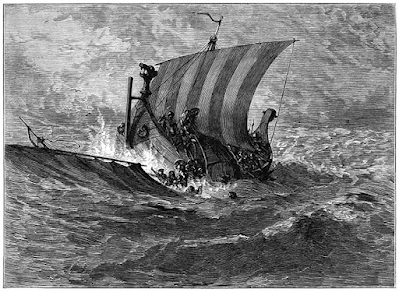
A viking longship in a storm, people are hanging off it in the sea


Wolves of water
Might of blind force 
Living movement of sunlight 
Currents churning 
The reflecting edges of the shale 
Soft rains pierce hard marble 
Heat seeps through the silver 
There is only mixing and dissociation 
Nothing remains 
What is the life that I have chosen? 
The wave-shattered hull 
Theseus in the labyrinth 
Hunched in a cave of broken myths

Ship of Theseus - Jute Gyre

Dragged off the street for some fictitious crime, you are led, in chains, to the dock. A longship is there. It is made of vicious thorns, from violet-grey daggers a metre long down to equally deadly hair-thin needles. Lashed to the barnacle-covered tiller is the Captain: two arms, one eye, and no legs. One of his ears has been chewed off. Gurning as though in agony, he peers at you with his remaining eye, and utters something sounding like "PARP!"

You’re led onto the boat, and chained to the oars, along with 2D6 others.

The sail fills and the whip cracks, and the boat veers hesitantly towards the Endless Sea.

D6 things the crew may tell you:

  1. No ship has ever returned from the Endless Sea.
  2. The Captain has been hired to recover valuable naval artifacts.
  3. The ship is alive, and malevolent.
  4. The captain left the rudder once and immediately started coughing up blood.
  5. The Captain has done this journey before. That’s where he lost his legs
  6. The ship has a true name, used to control it. Only the Captain knows what it is.
Giant Depair by Luis Rhead - A viking oarsman looks pissed off


I am writing an adventure for Mörk Borg. This is the beginning.

Thursday, 19 August 2021

Coin Magic Taint


I wrote here recently about coinage and treasure hoards in RPGs. Well here's something a little more lighthearted about money...

Magic leakage is a subject that has been long known about, but little discussed as it only happens very slowly, weakly, and only affects very small objects. Its effects are rarely even observable. However when large piles of coins and magic items are placed together for centuries at a time, as in, for example, a dragon's hoard, this leakage may result in coin magic taint.

Coin magic taint, the enchantment of coins through long contact with magic items, can exhibit in many ways. The most common is an attraction between affected coins and sources of magic (most commonly the same magic items that affected the coins, but if these cannot be found then any magical source will suffice). This can get players into a lot of trouble if they pay for goods using tainted coins - the coins will often creep out at night-time and attempt to roll themselves back to the players so they can once more bask in the magical aura of the players' possessions.

The opposite is also the case: in the unlikely event that players get hold of magically tainted coins, perhaps in payment for selling their treasures, they may find these coins gradually escaping from their possession and making their way back to their preferred location.

Other magical properties can be absorbed by coins: perhaps if they have been in contact with a cloak of invisibility, they will be observed to fade in and out of visibility. If tainted by a magical weapon, they may conceivably used as irregular but deadly ammunition for a sling.

What other weird behaviour have people observed from these magically tainted coins?

Thursday, 12 August 2021

I'm Sorry Did You Say Street Magic?

Illustration by Shannon Kao for ISDYSSM


 In the last few days I've discovered and played 3 games of I'm Sorry Did You Say Street Magic (I'll call it ISDYSSM from now on) by Caro Asercion. I've also introduced a number of people to the game, including several who'd never played RPGs before. All have fallen in love with its beautiful, simple system of playing, and the genuinely magical creations that result from playing it. One RPG-newbie I played with, a counsellor for autistic young adults, thought that the game would be an ideal tool for playing with her clients, helping them to come out of themselves and express their hopes and fears through directed creativity. 

ISDYSSM is a GM-less game - all players take an equal role in determining what is possible. This is a concept which, when I first encountered it, I couldn't envisage how it would work. But it does. It is, more than anything else, a loose structure within which people can explore the extremes of their imaginations to collaboratively build a story.

The rules, as I said, are simple and lightweight. After loosely describing a city by choosing three adjectives and then discussing the setting and what kind of beings might live there, players take it in turn to add either a Neighbourhood, a Landmark or a Resident to the city. Each of these involves a slightly different process, but all require the creation of true names, words or phrases that make that Neighbourhood, Landmark or Resident unique. These are a lot of fun to come up with, and can be as weird as you like: examples might be "slow-moving tourists", "big stain underneath", "oxidisation" or "braised tofu smell".

Declaring a resident involves an additional step of roleplaying a vignette, wherein the current player acts as the resident, and other players play roles of those interacting with them - perhaps customers, employees, or more abstract elements such as the weather or the nearby buildings. This aspect of the game was a lot of fun!

Finally, compasses - a word or phrase to inspire the round - and events - during which the city may be changed, and questions asked - help to make each round of the game unique, and determine the story of the city's growth and progress. The end of the game can happen whenever the players want - or you could keep on playing forever over multiple sessions if you prefer.

As well as being a lot of fun, it's a great tool for generating unique and characterful city environments for inserting into other RPGs or as a location for works of fiction.

In our first game, we invented the "Walking City of Lig⤦" (we think it may have once been called the Walking City of Light, but some of the letters have clearly fallen off the sign). It's a "sprawling, ornate, kinetic" city with something approaching a faded steampunk feel, where the buildings walk around on legs and the districts rearrange themselves over time. Quite unexpectedly, around halfway through the game, the city exploded into a battle between humans and robots, instigated by an android dishcloth-selling magnate in a tiki bar. You can read the summary of our gameplay here. 

In our next game we created an alpine city of cable-cars, where the building of a tunnel led to intrigue and death.

ISDYSSM is enormous fun, easy to play on the tabletop or online with only minimal resources (pen and paper), and a great introduction to RPGs for newbies. The rules are simple enough to learn that by my second play I didn't need to refer to them once. I can thoroughly recommend it, and will definitely be playing it again.


Monday, 9 August 2021

Old Maps & Ordnance Survey


I love real-world maps. There's just so much you can do with them.

In the mid-80s, I was part of a very short-lived play-by-mail game set in a a post-apocalyptic future. Each player controlled a tribe in a future Britain. On joining the game, you were sent a tiny square of 1:25,000 OS map. Mine was on a moor somewhere in the north of England, crossed by a line of electricity pylons.

The idea that everywhere on the Ordnance Survey map had a parallel in this game world blew my mind. It had that feeling of endlessness that was part of so many of my childhood fantasies. And anyone could get hold of the maps, but until you'd explored them in the game world you could only imagine what part of that future territory they represented.

When I started writing my Peakrill campaign last year, I stole this idea. My campaign is set in a fictional Peak District, and so the OS maps of the Peak District form part of my source material. I'm redrawing the maps, partly to simplify them, partly for the pure pleasure of drawing maps. But I could just as well have used the originals. Old maps are even nicer than the modern ones, and there are some great out-of-copyright OS maps available on Open Street Map. 


Maps can also be a great source of inspiration for naming things. One of my favourite writers, M John Harrison, does this often, especially in his Viriconium books (I have written before about how much the naming of things in Viriconium has affected me). I only recently realised that Canna Moidart, some time Queen of the city, is a place in Scotland.

Almost all of my D&D characters have been named after places in the Peak District - notably Bleaklow and more recently Bolsterstone. Harrison himself had a character called The Youlgrave in, I think, Viriconium Nights - named for the Derbyshire Peak town.  

The map may not be the territory, but nor is it merely a single-function object. What other uses do you put real-world maps to in your RPGs?

Tuesday, 27 July 2021

In my end is my beginning


I've written a role-playing game. It's not the one I had expected to write. There are no fairies. Unless you want there to be.

Short and sweet, it's my entry for the The One-Page RPG Jam 2021. You play a person who is about to die. It's funny, most RPGs contain death, often lots of it, but they only treat it as a technical issue and something for players to avoid (unless they're inflicting it on someone else). There's never much space to consider what death really means. In the last few years, I have made friends with an undertaker, have lost my father suddenly, and have seen one of my closest friends publish an astounding novel about death.

Oddly, I felt the need to add "content warning: death" to this game, and it struck me as really quite peculiar that no other game I'm aware of does this, despite the trauma that death can cause.

Anyway, enough of the lecture, here is IN MY END IS MY BEGINNING

Tuesday, 23 February 2021

Appendix N


Since returning to gaming this year, I don't seem to be able to lift a stone without finding something about Appendix N beneath. Appendix N of the Dungeon Master's Guide contained Gary Gygax's "Inspirational and Educational Reading" - a list of authors who inspired Dungeons and Dragons.

I must have read the DMG dozens of times throughout the 80s, and yet I have no memory whatsoever of Appendix N. Perhaps because it didn't relate directly to gaming, perhaps because I was already reading many of these authors, and would doubtless be reading the rest in good time. Whatever, it left no impression on me at all. And so it's strange that, in 2021, it seems to be namechecked on almost every blog I visit.

So it was interesting and apt to receive an email yesterday from the wonderful Strange Attractor Press notifying me that they have just published a book called Appendix N - The Eldritch Roots of Dungeons and Dragons.

Meanwhile, here's my Appendix N:
  • Viriconium Nights by M John Harrison
That's it. That's about all you need. The other Viriconium books are great, but Nights contains their pure essence. I've written before on my main blog about how Viriconium changed my life and about my recent return to Viriconium. In essence, the Viriconium books ended fantasy for me forever, they pulled back the curtain and showed the sad little men behind. Fantasy is almost entirely about epic battles of good vs. evil, it is the distillation of the lie of cowboys and superheroes. It is a load of old pernicious bollocks.

I read Viriconium Nights book in 1986, and I've scarcely felt the desire to read a fantasy book ever since. 

Read a proper book. Read some history, some psychology, a little biology and physics. Read novels by Robert Irwin, George Saunders, Magnus Mills, David Mitchell. Read "magical realism". Read old shit. Read widely and well. But, while I'm sure there are exceptions, I advise giving fantasy a wide berth.

I shall probably be buying the new Strange Attractor book. So help me.

Thursday, 18 February 2021

Why Peakrill?

The Hope Valley - old OS map and my interpretation

What is a Peakrill, and what relevance does it have to this blog? Well, the what part is easy: 

Peakrel (also Peakrill, Peakril) - Pronunciation /ˈpiːkr(ə)l/  - NOUN, rare British - An inhabitant of the Peak District.

What a brilliant word, eh? And as for the why, well it relates to the campaign that I am writing. For more, read on...

Wednesday, 17 February 2021

Money and coinage in RPGs

Dinar of Varahram III by Ashley Van Haeften


I recently read the book Debt: The First 5000 years by David Graeber, and as well as turning my ideas about money on their head, it got me thinking about the way that money is handled in RPG rules (I'm talking D&D-alike fantasy RPGs here, although I imagine that some of these points can be applied to other genres).

All 5s and 7s poetry dungeon


Here is my response to Patrick Stuart/False Machine's challenge to write a poetry dungeon - in this case, more poetic than playable, and not very poetic at that - All 5s and 7s.


Tuesday, 4 August 2020

roll d12


Wherever possible, I use D12s in my adventures, especially for random encounter or treasure tables. Why? I don't know, I just started doing it.

I think I feel an affinity with that slightly odd, loner die, hardly ever picked for the team because of its strange shape. obviously yer d12 is not as wacky as yer d4, but yer d4 is a bit of a showy bugger. It's out to get your attention. And it works, doesn't it!

So here's to you, d12. Keep on rollin'!